

About the Restoration Investment Calculator
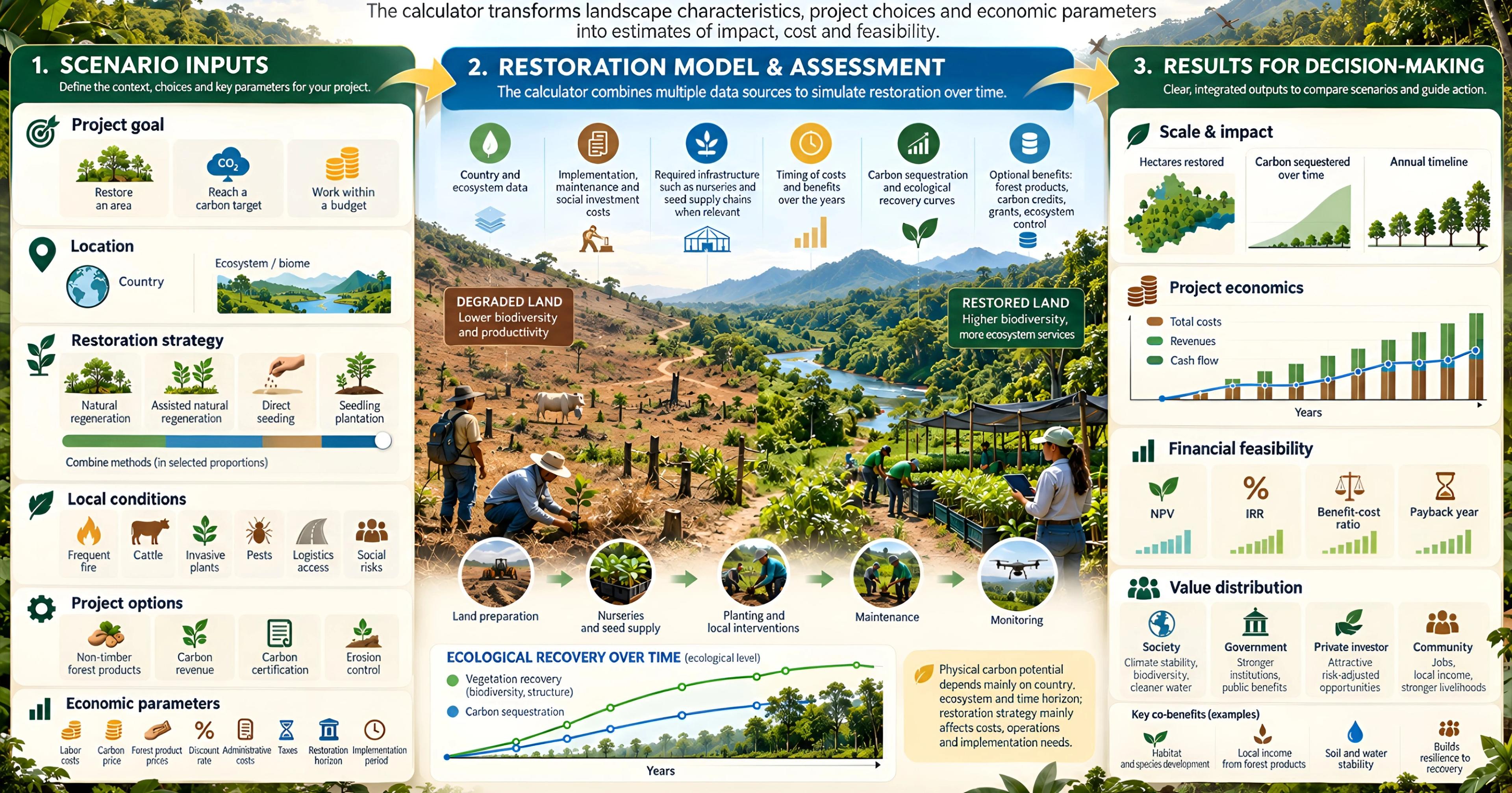
This Restoration Calculator is an interactive web application designed to support the planning and evaluation of ecological restoration projects. The tool enables users to simulate restoration scenarios by entering key project parameters such as country and ecosystem, restoration goals (area, carbon sequestration, or budget), the mix of restoration methods, context constraints, and economic variables including discount rate, carbon price, NTFP price, and labor cost.
The calculator dynamically computes annual cash flows, Net Present Value (NPV), and Internal Rate of Return (IRR) using scientifically grounded formulas that account for carbon sequestration curves, restoration costs, and potential revenues. Results are presented through intuitive charts and summary cards, providing clear insights into the economic and ecological outcomes of different restoration strategies.
User guide: steps to use the calculator
Select the country and ecosystem for which you want to estimate restoration costs and benefits. Availability varies by country, and only one ecosystem can be selected at a time. Sub-ecosystems cannot be selected.
Choose a quantitative goal and enter your target value. You can calculate restoration costs and benefits based on area (hectares), carbon sequestration (tCO₂e), or total project budget (USD).
Set the proportion of each restoration method by entering percentages for the available approaches. Some methods may not be available for certain ecosystems. The total must equal exactly 100%.
Select any applicable Optional Goals, including NTFP production, carbon, and erosion control, to incorporate additional benefits and associated costs into the restoration model. For NTFPs, due to data limitations, the calculator includes one representative product for each ecosystem–continent combination.
Specify local site conditions and Context Constraints, such as access limitations, social risks, fire, or cattle invasion. Associated Context Interventions add costs to the baseline implementation scenario, helping account for less favorable and heterogeneous local conditions.
Adjust Detailed Parameters, if needed, including cost assumptions (e.g., labor and discount rates), revenue projections (e.g., carbon and NTFP prices), stakeholder financing models, and operational variables (e.g., planting density and project timeline).
Review the calculated results, presented separately for each restoration method and as an aggregate weighted by the selected mix of methods across the restoration area. Based on your selected goal, the calculator estimates the corresponding costs, benefits, and key financial indicators, such as the project's net balance and rate of return.
Explore results from different stakeholder perspectives. The Social perspective is the most comprehensive, accounting for all tangible and intangible costs and benefits. Results are also presented from the perspectives of the Private Investor, Government, and Community, each considering the costs, benefits, and financial flows relevant to that stakeholder.